1. Home
  2. |
  3. Blogs

Blog

Florida school bullying prevention guide

Bullying Serious Problem in Florida Schools

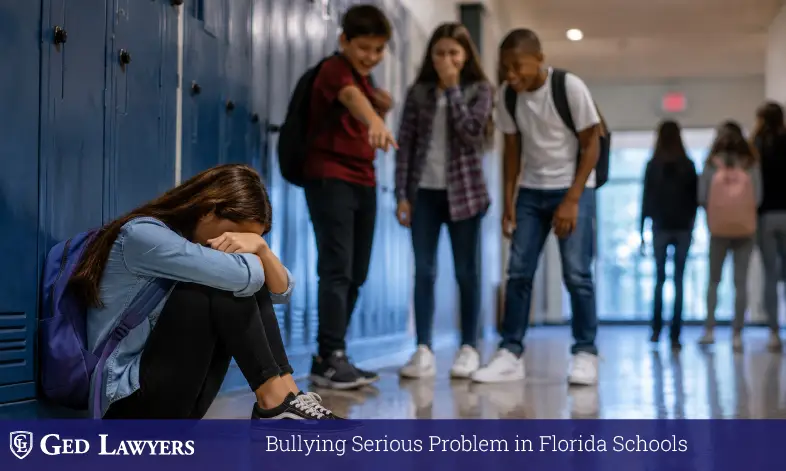
Bullying is a serious problem in schools nationwide, and Florida is no exception. Our Panama City personal injury attorney explains the most common types of bullying that occur in Florida schools, why bullying is so underreported, and how parents and schools can help.

Bullying in Florida Schools

According to the National Center for Education Statistics, 31% of students between the ages of 12 and 18 attending school in the United States say they are bullied. However, the reality may be far more complicated. Like most incidences of abuse that involve imbalances of power, victims of bullying are often more likely to stay silent about an incident than to report.

The numbers are further complicated in Florida due to how our state’s laws on bullying are worded. Florida public schools report a bullying rate of only 0.1%. However, experts believe that Florida’s low numbers have more to do with the way in which the law classifies bullying than actual occurrences of it.

The definition that is used in the law and by the Florida Department of Education to determine what does and does not count as bullying says it must involve “systematically and chronically inflicting physical hurt or psychological distress” on someone.

Therefore, schools look for the following three criteria, sometimes known as “RIP,” before they consider an act “bullying”:

  • Has the harassment been repeated over time?
  • Was there an intent to cause harm or distress?
  • Is an imbalance of power (or a perceived imbalance of power) involved?

Words like “chronically” and “repeated” prevent a lot of people from being able to report one-time incidences that can be very hurtful and may be keeping Florida’s school bullying numbers far lower than they actually are.

Common Types of Bullying

Bullying can come in many forms both physical and psychological. Though children who stand out, have disabilities, or don’t have many friends tend to be the main targets of bullying, the truth is that it can happen to anyone at any time and at any age.

The most common types of bullying as described by Florida law tend to involve:

  • Cyberbullying
  • Destruction of property
  • Harassment based on sex, religion, race, or disability
  • Intimidation
  • Physical violence
  • Public or private humiliation
  • Social exclusion
  • Stalking
  • Teasing
  • Theft
  • Threats

In Florida, the bullying or harassment of any student of a public K-12 educational institution is prohibited by law. However, due to the fact that such incidences must be repeated to be taken seriously, this can be hard to enforce.

What Can Schools Do About Bullying?

Unfortunately, it can be very difficult for teachers and administrative staff to stop bullying in schools. Since a lot of students don’t report it, adults are often unaware that bullying is even happening in the first place. When they do find out, it can be hard to distinguish whether an incident is a systemic act of bullying or a relatively harmless one-time squabble.

Teachers can have a good influence on their students by being transparent about the realities of bullying and offering support to those who have been victimized. Though it may sound counterproductive, it is important to offer support to both the victim and the aggressor when an act of bullying occurs. Otherwise, if the bully’s aggressive behavior is not addressed and allowed to persist, it can become a lifestyle.

If you are a parent or teacher who catches an incident of bullying, separate the children and gather the facts about what happened as well as what may have led to the situation. Allow everyone involved to understand why the situation occurred and offer them guidance and alternatives so they can prevent it from happening again. And if a child comes to you to report an act that made them feel as though they were being bullied, don’t brush it off. Believe them and offer what support you can.

If know someone who has been bullied and suffered physical or psychological harm, we may be able to help. Contact our Panama City personal injury attorney for a free case evaluation. You can also report bullying to the Florida Department of Education according to the guidelines listed here.
By : Clarissa Romero

October 17, 2022

Spring Break Balcony Fall Investigation

Spring Break Visitor Killed After Fall From Balcony

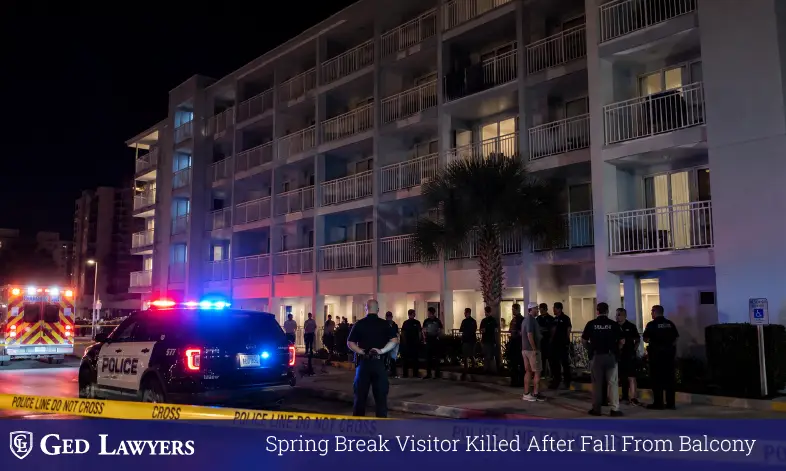
WJHG is following a story that caught the attention of our Panama City premises liability lawyer. 21-year-old Jacob Winkler was enjoying Spring Break after arriving in Panama City Beach from his home in Menomonee Falls, Wisconsin. The trip took a tragic turn early Saturday morning when Winkler fell from a 7th floor balcony at the Gulf Crest Condominiums.

Winkler, who was a student at the University of Wisconsin’s Milwaukee campus, was pronounced dead at the scene. An autopsy is planned to determine more details. No foul play is suspected, but presumably the inquiry will consider whether alcohol played a role in the fall. The victim’s friends have expressed shock and grief as the news of the tragedy spread.

This is actually the second time this year, and the third in the past four months, that a fall in Panama City Beach claimed a life. Details on the earlier falls can be found in reports from The News Herald. On Monday January 2, 2012, 21- year-old Justin Alexander Seamus fell from the 10th floor of a parking garage located at 9902 S. Thomas Drive in the Laketown Wharf condominium. The Callaway native was pronounced dead at the scene.

Another fatal fall occurred on December 3, 2011 and claimed the life of 22- year-old Aaron Scott Thompson from Kalamazoo, Michigan. Thompson fell from the 7th floor balcony at the Holiday Inn on Front Beach Road. Circumstances surrounding the two more recent falls have not been reported, but investigators concluded that Thompson’s fall followed altercations with family members and a security guard.

While we do not have the details to make a full legal analysis of the three recent accidents, balcony falls can give rise to a Panama City premises liability claim if the balcony area has not been built or maintained in a safe fashion. The defendant in a premises liability claim can be the property owner, the party that manages the location (like the party who owns a business at a rented location), or the tenant (i.e. the person living in an apartment managed by one company and owned by another). The legal inquiry into fault focuses on which person or entity bore responsibility for maintaining the safety of the area.

If you are involved in a property-related injury, you should take steps to protect a potential legal claim. Of course, medical care should be your first concern, but you should also take care to document the incident. Get the contact information for any witnesses and document the scene, ideally with photographs or video. Report the incident to the property owner of manager, and keep records of all correspondence related to the accident. Contact an experienced Panama City injury lawyer in a timely fashion so your counsel can also examine the scene before it is substantially altered and help you to determine who bears legal fault for the incident. Do not sign any agreements prior to obtaining legal representation.

Ged Lawyers has experience in slip-and-fall and other premises liability cases. Our phones are answered 24/7 and most injury cases are handled on a contingency basis, which means that you only pay legal fees if we help you to receive compensation for your injuries.

By : Clarissa Romero

October 17, 2022

Holiday Pay Workers Compensation Eligibility

Can You Get Holiday Pay While Receiving Workers’ Compensation?

Accidents never occur at convenient times – sometimes, they happen around planned vacations, or during the holidays. If you’re currently recovering from personal injuries and are receiving workers’ compensation, don’t assume that you won’t be allowed to receive vacation pay, too. It’s possible for workers to collect benefits from both.

Defining Workers’ Compensation

As an employee, it’s important to understand your protections in the workplace. Workers’ compensation insurance helps to protect you as well as your employer from financial loss when you’re injured while working, or you become fill from a work-related cause.

Workers’ compensation can cover expenses including:

  • Medical bills, including X-rays and hospital stays
  • Ongoing care costs
  • Lost wages from missing work
  • Funeral expenses if an employee dies

Workers’ compensation is paid by your employer’s insurance and does not cover any injuries sustained from being intoxicated in the workplace, injuries sustained from a fight started by the employee, or any emotional injuries that exist without physical trauma.

Collecting Holiday Pay & Workers’ Comp: Union Members

If you’re a union member and your employers has a collective bargaining agreement, you may be eligible to access your holiday pay while receiving workers’ compensation benefits. In most cases, vacation pay would be taken out of your compensation checks if you’re currently receiving workers’ compensation. Your agreement may allow you to receive both.

What If You’re Not a Union Member?

If you don’t belong to a union, the terms of your employment contract may be able to help you access your holiday pay without it being docked from your compensation. Some employers require workers to have been working within 60 days of vacation in order to receive holiday pay. If your contract states that vacation pay is calculated based on work performed for a certain period prior to the holiday, it’s possible to receive the pay while you have workers’ compensation.

We Can Help You Collect Successfully

Navigating employment and personal injury law can be confusing and involve a lot of paperwork and details. Our attorney has years of experience and can examine your contract to determine whether it’s possible for you to be paid for the holidays while you recover from your injuries using workers’ compensation.

Contact us online at Ged Lawyers or call us at (844) 949-2794 to speak to our attorney with over 30 years of personal injury law experience. We’re here to help you heal.

By : Clarissa Romero

October 17, 2022

Florida Limitations Vs Repose Statute

What Is the Difference Between the Statute of Limitations & the Statute of Repose in Florida?

Statute Of Limitations vs Statute Of Repose

Every state has set deadlines for taking legal action in a personal injury claim. A person can only file a lawsuit from the date of an accident or injury until a certain amount of years have passed. This is called a statute of limitations. A statute of repose is a very similar type of restriction, but typically comes with stricter limits.

It’s up to you to know your statute of limitations and statute of repose deadlines and take swift action to protect your claim following an accident. Our attorneys outline the statute of limitations vs statute of repose below and can guide you through how these actions can affect your personal injury case.

What Is a Statute of Limitations?

A statute of limitations is the amount of time you have to file a lawsuit against the individual or entity who is at fault for your accident. Under Florida’s statute of limitations for personal injury cases, you have two years from the date of the accident to file your case. Extensions are possible if you don’t “discover” you have sustained incident-related injuries until much later. If you are curious about other exceptions, talk to an attorney for details.

If you don’t settle your claim with an insurance company or file a lawsuit against the person or business at fault before the statute expires, you’ll lose the right to pursue any compensation for your injuries. Insurance companies are under no obligation to help you settle your claim before the deadline. They know if you haven’t sued the person or entity they insure before the statute expires, they win.

What Is a Statute of Repose?

A statute of repose is similar to a statute of limitations, but there are certain crucial differences. A statute of repose also dictates how much time a person has to pursue certain legal rights following an event such as an accident or crime, but the terms are much stricter.

A statute or repose is designed to bar legal action after a specific set date, no matter when the claimed injury or defect is “discovered.” This means extensions and exceptions are highly unlikely.

However, there are rare instances in which extensions are allowed. In 2018, changes were made to Florida Statute § 95.11(3)(c) regarding construction statutes of repose. The amendment made it possible for contractors and developers to be sued for construction defects more than ten years after the completion of the project. Prior to this change the ten-year deadline had been immovable; now, a one-year extension is allowed under certain circumstances.

To put the differences between the two in clearer terms, let’s continue to look at construction accidents and defects as an example:

  • Florida’s statute of limitations allows a claimant two years to bring a lawsuit after a project is completed or upon discovery of any latent defects.
  • Florida’s statute of repose allows ten years (or more, thanks to the 2018 amendment) following the completion of a project to file a claim, regardless of when the defect was discovered.

How Can These Two Actions Impact Your Personal Injury Case?

When filing any personal injury claim, it is always best to start as soon as possible following your accident. Evidence that is fresh is much easier to collect and document than old evidence. Your memory will also be more reliable immediately after an accident and the opposing insurance company less involved. You’ll also want to retain a lawyer as quickly as you can. The sooner we can start investigating your claim and building your case, the stronger it will be.

Here are some steps to take following your accident or injury if you want to file a personal injury lawsuit:

  • Seek medical attention right away so there’s a record of your injuries
  • Document important information such as the at-fault entity’s insurance information and witnesses’ contact information
  • Don’t say anything to or sign anything from an insurance company
  • Keep a file with any other notes, observations, and information that might help your case
  • Contact a lawyer

The quicker you act and the more through your documentation, the less you have to concern yourself with statutes of limitations and repose. Personal injury claims can take months if not years to settle, so time is of the essence.

Don’t Wait to Get Help Today

Have you recently been in an accident and are looking to file a personal injury claim? Or do you have a question about the statutes of limitations and repose? Reach out to our firm today. We’ve been handling personal injury cases in and around Florida for over 30 years.


Contact Ged Lawyers today at (844) 949-2794 or message us online.

By : Clarissa Romero

October 17, 2022

Proving Florida Hit Run Accidents

Proving and Penalizing Hit & Run Accidents in Florida

Hit and run crashes are disturbingly common in the U.S., a hit and run occurs roughly every 43 seconds according to data from the AAA Foundation for Traffic Safety. Of course, some hit and run accidents are victimless crimes, like a small parking lot scrape during a botched parking job, for instance. Yet, hit and runs can be deadly as well.

Florida hit and runs are especially dangerous and result in many fatalities every year, including claiming the life of an up-and-coming Florida MMA fighter only a few years ago. In 2018, Florida was among the top 3 states with the highest per capita rates of fatal hit and run crashes.

According to state law, the legal consequences for committing a hit and run accident varies depending on whether mere property damage occurred, or someone was injured or killed. Florida auto accident attorney Ged Lawyers explains what you need to prove a hit and run accident occurred and how offenders are punished.

Proving Liability in a Hit & Run Accident

Florida hit and run laws were updated in 2014. According to Florida Motor Vehicle Statute 316.061, drivers have a duty to remain at the scene of an accident and do what they can to help. Motorists who don’t follow this rule are subjected to punishments depending on the severity of the damage they caused.

How to prove a hit and run:

  • You must provide proof that the person who fled the accident scene was the driver of a vehicle involved in a crash resulting in property damage or injury to or death of another person or people
  • You must provide proof the driver either knew or should have known they were involved in a car accident
  • You must provide proof that the driver knew or should have known that property damage, injury, and/or death of another person or people occurred
  • Last, you must prove the driver intentionally failed to stop at the scene of the crash or failed to remain at the scene long enough to provide identification to the other affected parties, or the driver failed to provide “reasonable assistance” to the injured person or people if such treatment appeared to be necessary or was requested

Florida Hit And Run Laws

There are three types of legal penalties for drivers who cause hit and run accidents in Florida, depending on the amount of damage they caused.

These penalties are as follows:

  • Accidents involving property: This type of hit and run is classified as a second-degree misdemeanor. Penalties include up to 60 days in jail and a $500 fine.
  • Accidents involving injury: This offense is considered a third-degree felony. Penalties of up to 5 years in prison or 5 years of probation and a $5,000 fine may be sentenced to the driver who caused the accident.
  • Accident involving death: This type of offense is classified as a first-degree felony, with penalties of up to 30 years in prison and a $10,000 fine.

How Ged Lawyers Can Help

In addition to the hit and run driver being sentenced to pay a fine and/or jail time for their crime, they may also be held liable for the injured parties’ medical and repair bills. In order to receive compensatory damages, however, you will have to file a personal injury claim. Occasionally, punitive damages are available as well.

With the help of a lawyer, you can ensure that you will receive the maximum compensation available. If you would like to file a personal injury claim against a hit and run driver, or you have questions about what to do following a hit and run, contact a personal injury lawyer.


If you or a loved one has been injured in a hit and run accident, reach out to Ged Lawyers today. You can call us at (844) 949-2794 or contact us online to schedule your free, no-obligation consultation.

By : Clarissa Romero

October 17, 2022

Important knee replacement recall guide

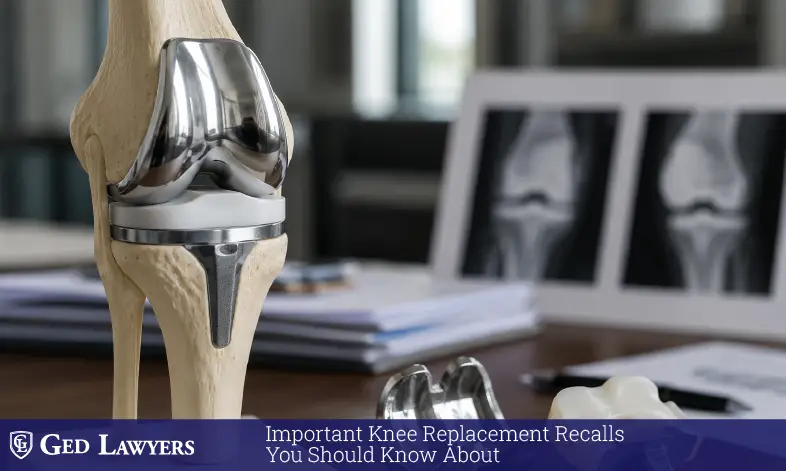
Important Knee Replacement Recalls You Should Know About

There have been a disturbing number of knee replacement recalls since the 2000s. In some cases, systems have been known to rot inside the body, requiring more surgery to have them removed. In other cases, a medical device, although faulty, cannot be removed due to its integration into the body.

Knee replacements are important. They are the fulcrums that are responsible for mobility, but they are also crucial to the overall structure of the body. When they go bad, everything else suffers. Bad knee devices can affect posture and walking, and damage other areas of the body in the process. Even if standing and mobility aren’t an issue, poor joint devices can cause pain in the very areas they are meant to help.

Why Do Knee Replacements Get Recalled?

There are a number of reasons why a new knee needs to be recalled. All of them are due to faulty design, incomplete testing, or unexpected wear.

Faulty design refers to the device being poorly made to begin with. Perhaps it doesn’t bend as far as it should, or it bends in the wrong direction. The device itself could be badly held together, and some have even been known to have pieces fall off into the surgical site while being installed.

Sometimes knees replacements don’t fit properly. They aren’t designed with correct body proportions, and surgeons can even break them when trying to make them fit.

Shoddy knee replacements can go loose over time. For example, if the company didn’t do any long-term testing, they wouldn’t be aware that the tightness of the joint doesn’t hold long term. This causes patients to be stuck with sliding, detached knees in their legs. Related to this are knees that wear down over time. Once again, the product was likely rushed out, and no one was aware that the joints would slowly deteriorate, leading to loose knees.

Sometimes the product itself is okay, but its packaging is poor. During shipping, the device is damaged or exposed, making it unsterile.

One of the more absurd reasons for a recall is mixing up parts. Left-shaped components are mingled with right-shaped components. This makes devices difficult to install, since surgeons get confused about which piece goes where. This could also lead to a great deal of pain and mobility problems when installed, since the body is using artificial bones that are shaped in the wrong direction.

Companies with a Large Number of Knee Replacement Recalls

In roughly the last 20 years, three companies have been responsible for the majority of knee replacement recalls.

DePuy

One of the biggest offenders of faulty knee tech is DePuy. Since 2003, they have had over 477 separate recalls on record., with the most recent in 2017. This number reflects 477 separate brands of devices and tools, not the total number of individual pieces that were recalled. What’s more, it isn’t just the devices themselves that have been recalled. In 2015, DePuy recalled a staggering number of tools related to their knee devices, almost 14,000 in total.

Zimmer Biomet

Zimmer Biomet is the biggest knee replacement company on the globe. It has had 377 separate recalls since 2003, and, again, this number reflects separate brands being recalled, not the number of individual pieces that were pulled off the market. Like DePuy, Zimmer Biomet had a big recall in 2017. Over 28,000 individual joint components were sent back due to their toxicity.

Stryker

Stryker’s recalls are less worrying than the other two companies, but it is still worth being skeptical of their product. Going back to 2003, 125 of their products had to be recalled.

They did earn a bit of favor when they voluntarily recalled one of their products, the ShapeMatch Cutting Guides, which was meant to give surgeons a precise size and shape for cutting bone to install the artificial knee. It didn’t work. Injuries and pain were reported to the FDA, and Skyler pulled the product. Even after that debacle, Skyler found themselves implementing two more recalls a few years later.

Getting a Knee Replacement

Before agreeing to have anything implanted, make sure to research the product and the company. Avoid using products from companies with a long track-record of recalls or lawsuits against them. If the doctor is aggressive about that product and can’t or won’t use another brand, find another doctor.

If the insurance company won’t approve a device from another company, seek other options. There may be discounts or payment assistance programs available with other brands. Do not act out of desperation. However bad the current discomfort may be, it’s not worth the potential damage of implanting something that will have an even worse, damaging effect later.

Consequences of a Bad Knee Device

As stated above, knees make up a big part of the overall structure of the body. Poor support in the legs leads to strain on other areas of the body. Constantly shifting weight to avoid pain becomes a problem. Favoring any one part of the body to avoid discomfort leads to damage somewhere else.

Infection is a huge concern for bad joint replacement devices. If a device starts to rot or go rusty, that can spread to the surrounding tissue. Now the patient has a potentially life-threatening problem. The inside of their leg is black with infection, and that tissue needs to be treated. If antibiotics aren’t enough to do the trick, surgeons may need to start removing portions of the leg tissue to save someone’s life. At its most extreme, infection could require an amputation.

Bad knee devices can lead to blood clots in the lower legs, a dangerous area. When blood clots dislodge, they travel up the arteries and create deadly blockages in the heart, lungs, or brain. A loose, untreated blood clot is deadly.

Surrounding bone may be in danger when a device is faulty. Depending on the nature and the location of the malfunction, bone connected to the device can break, fracture, splinter, or wear down.

Once a Device Has Been Recalled

Unlike a car, a medical device recall – particularly for a device that has been implanted in the body – doesn’t mean that the company takes back the device and pays for a replacement. Right now, there isn’t much of a direct plan in place when a medical device malfunctions. Patients are stuck with whatever is inside of them the same as if it were their body parts. From there, the patient must decide if living with the pain is worth it.

A device that has failed so spectacularly that it starts to cause other medical issues – like a rotting joint poisoning the body – has to be treated like any other medical problem. This is to say that a person would need to see a doctor, who recommends a surgery. The surgery is scheduled, and the device is removed or replaced. Any extra damage caused by the device is treated in whatever way necessary. The patient, along with their insurance, then pays the medical bills.

This is why a good lawyer is so important. The patient is the last person in the chain of the manufacture, distribution, recommendation, and implantation of a medical device. They should be able to trust that all necessary testing and approvals have been conducted on this device. It’s not their job or their problem to decide what is ready for public use.

Lawyers are needed to recover the cost of a failed medical device. They have the expertise to go after the responsible parties for medical bills and pain-and-suffering compensation. If replacing or removing the device is unfeasible, a lawyer may be able to get a large, lifelong settlement to ease the burden when related medical issues arise.

We are here to help if you or a loved one has suffered complications from a medical device. Call today at (844) 949-2794 or contact us online for a free consultation at no risk to you.

By : Clarissa Romero

October 17, 2022

Legal jurisdiction in civil courts

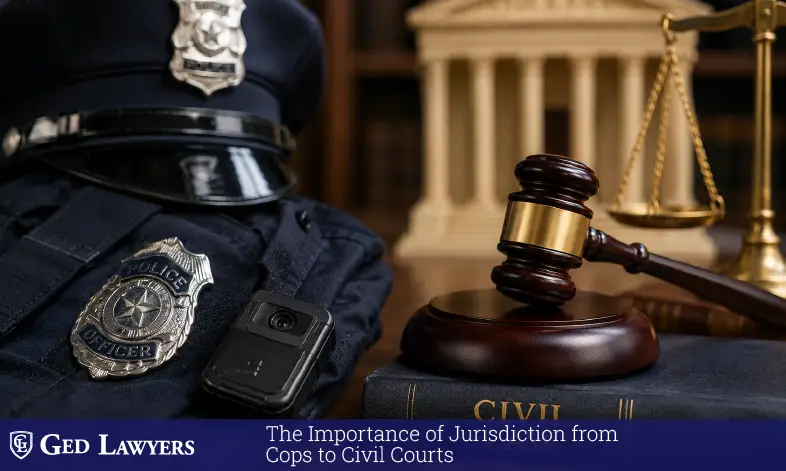
The Importance of Jurisdiction from Cops to Civil Courts

The world is becoming an ever-smaller place. With the Internet creating a “place” that exists apart from traditional notions of states, countries, or even continents, borders sometimes seem like an old-fashioned concept. Nonetheless, borders do matter when it comes to the law (as anyone who has watched offenders speed across the border in a movie will recall). In both the civil and criminal systems, jurisdiction is a key principle that ensures borders are respected. Issues of civil jurisdiction are particularly important to our Northwest Florida injury law firm given how close we are to two other states and the fact that tourism regularly brings out-of-state visitors to our area.

Cooperation Across Jurisdictions in Criminal Law Enforcement

On the criminal side, being located near the state border makes cooperation critical; a Florida patrolman may not be able to follow a drunk driver across the border and vice versa, but if peers can communicate and cooperate, everyone benefits. This week, WMBB wrote about a “Hands Across the Border” initiative through which Florida, Alabama, and Georgia law enforcement groups are partnering to save lives during the upcoming holiday weekend. Specifically, they are working together to combat drunk drivers and marking the 23rd year of these joint efforts.

Police are being extra-vigilant since, as Jackson County Sheriff Lou Roberts notes, it is “a very deadly time of year” and the roads are busy with people flocking to our local beaches. Agencies are paying extra attention to the US 231 corridor and Highway 90, including the use of undercover officers and sobriety checkpoints. The various agencies in all three states are working to ensure everyone returns home safe and encouraging drivers to be alert, to be smart, and to practice defensive driving techniques.

Civil Jurisdiction Part One – Subject Matter

Borders are also an issue on the civil side of the court system. In order for a court to be able to hear a case, the case must be within the judicial “borders” or, in more formal terms, the court must have jurisdiction over both the subject matter and the parties. On the subject matter side, personal injury cases typically fall under the jurisdiction of the state courts where the injury occurred or the parties are located. In Florida, county courts hear civil disputes that involve under $15,000 and circuit courts hear civil cases involving higher amounts. There are situations in which an injury case might be heard in a federal court, but the subject matter requirements are a bit more complex.

Civil Jurisdiction Part Two – Personal Jurisdiction

Personal jurisdiction is about the court’s authority to decide a case involving the parties, particularly the defendant. If the civil law didn’t place limits on personal jurisdiction, you could find yourself being sued in a far-flung state even if you’d never been to the state, never done business there, and had no involvement whatsoever with the state.

Generally speaking (and greatly simplifying a complex inquiry), a party must either reside within the court’s geographic area or have significant contacts with the area in order to give a court jurisdiction over the party. Florida’s long-arm statute provides an overview of acts that confer jurisdiction over a non-resident and also allow a court to call that non-resident before the tribunal.

Ensuring Procedural Rules are Satisfied and Our Client’s Case is Heard

Suppose our client is a Florida resident who was injured by a Georgia resident who was driving drunk on a Panama City roadway and there is more than $15,000 at stake (note: we also work with clients from other states who were injured while visiting our region, see the link below for more details). Both forms of jurisdiction are met and a local circuit court can hear the case. The jurisdictional analysis can get much more complex, especially when multiple parties are involved. Importantly, even in cases where subject matter and personal jurisdiction are relatively straightforward, an initial Complaint must detail both or it can be tossed out of court.

Even in today’s world, place and details matters. Jurisdiction is an important issue for both the criminal and civil systems. The police focus on jurisdiction when enforcing the law and our firm focuses on jurisdiction when representing the wrongfully injured. As a Panama City plaintiffs’ law firm, one of our jobs is ensuring that our client’s case is brought in the right court. While civil jurisdiction may not inspire a movie chase scene, it is still important to keeping the legal system in working order.

By : Clarissa Romero

October 17, 2022

Florida lane splitting laws guide

Is Lane Splitting Legal in Florida?

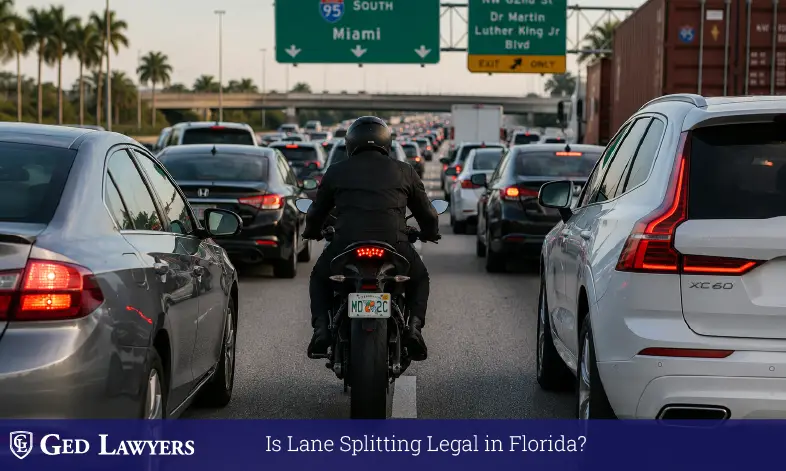
Lane-splitting is not legal in Florida, in fact, the only U.S. state that has legalized lane-splitting is California. Florida Statute 316.209 (3) reads “no person shall operate a motorcycle between lanes of traffic or between adjacent lines or rows of vehicles,” making this practice illegal throughout the state.

Though controversial in our part of the world, lane-splitting is legal in many areas of the globe, including in Europe and Asia. Despite this fact, while driving around in Florida you may have noticed bikers maneuvering their motorcycles through vehicles in traffic in order to get ahead of standstills.

What Is Lane-Splitting?

Lane splitting refers to maneuvering a motorcycle between two lanes of stopped or slowed traffic. Florida Statute 316.209 (3) reads “no person shall operate a motorcycle between lanes of traffic or between adjacent lines or rows of vehicles,” making this practice illegal throughout the state.

Lane-splitting is different from lane sharing, which occurs when bikers ride side by side in the same lane of traffic. Lane sharing is legal in Florida.

Is Lane-Splitting Dangerous?

Though the safety of lane-splitting is a topic of much debate, it is hard to say for sure one way or the other. Many motorists find lane-splitting to be dangerous (motorcycles seemingly appearing out of nowhere can be startling), or at the very least annoying. Many bikers, on the other hand, argue that lane-splitting is safer than sitting in bumper-to-bumper traffic because motorcyclists often get trapped between larger vehicles when in traffic with no escape route.

A 2015 study by the University of California Berkeley found that lane-splitting is “relatively safe”—if done in traffic moving at less than 50 mph by bikers who don’t exceed the surrounding vehicles’ speed by more than 15 mph. The study also concluded that motorcyclists who practice lane splitting were less likely to suffer head or torso injuries or be killed in a crash than bikers who did not use the maneuver appropriately.

The National Highway Traffic Safety Administration (NHTSA) has said that lane-splitting is “worthy of further” study in the hopes that the practice may prove to be a means of reducing congestion in addition to introducing possible safety benefits—lane-splitting motorcycle riders are far less likely to be rear-ended by motor vehicles than bikers who don’t lane-split.

It is for these reasons that California decided to legalize lane-splitting in 2016. Not enough official data pointing one way or the other has come out to provide a definitive enough answer for most bureaucracies, however, so lane-splitting remains illegal elsewhere in the U.S.

What Are the Penalties for Lane-Splitting in Florida?

Though technically illegal, many bikers get away with lane-splitting on a regular basis, and often without consequence. If a cop does pull you over for the act, you could get a ticket of upwards of $100 (the fine varies by county). You may also be held liable for damages if an auto accident occurred while you were lane splitting.

Injured in a Motorcycle Accident? Call Our Firm Today

Were you hit by a motor vehicle while lane-splitting in Florida? Or have you suffered harm when riding your motorcycle because of the negligence of another driver? Our Panama City motorcycle accident attorney has over three decades of legal experience and is equipped to handle all sorts of injury claims in Florida.

By : Clarissa Romero

October 17, 2022

Windshield insurance claim lawyer guide

Why Should I Get a FL Windshield Claims Lawyer?

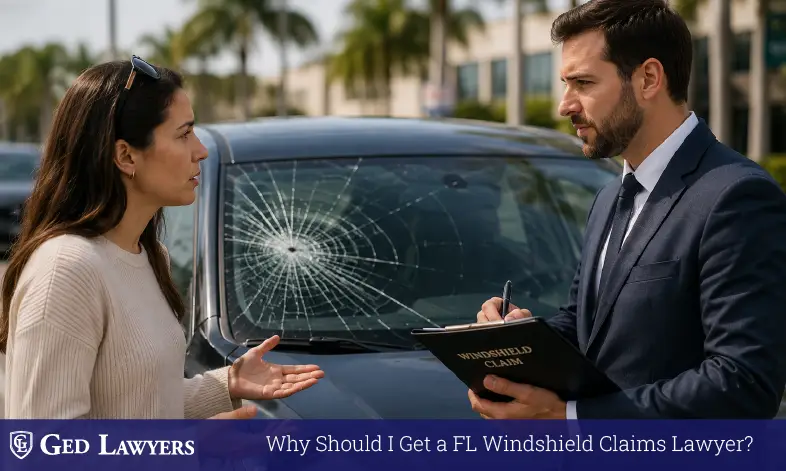
A windshield is often the only thing standing in the way of you being seriously injured while driving. As the only barrier between you and debris such as rocks and blown-out tires, it is critical to being able to drive safely. When your windshield shatters, either due to a crash or debris, you count on your insurance company to reimburse you for the damage so that you can make the necessary repairs and get back on the road. However, many people find that their windshield claims are denied, despite having paid for the coverage. Without having your claim approved it can cost a thousand dollars or more to have your windshield replaced, which is prohibitively expensive for most drivers. The good news is that you are not out of luck. An experienced windshield claims attorney can help you to get the coverage that you need so that you are able to get back on the road without having to incur a huge financial burden.

How a FL Windshield Claims Attorney Can Help

We pay for insurance every month, so we expect it to be there if we ever need it. However, it is important to remember that our goals and expectations are at odds with those of the insurance company. Insurance companies would profit far less if they paid the full amount of coverage to everyone who filed a claim. Insurance claims adjusters may seem friendly and like any other customer service agent, but they are employed by the insurance company, so their goal is not to help you, but rather to find ways to deny your insurance claim or to settle it for as little as possible. For this reason, it is important to be incredibly cautious when talking and sharing information with an insurance claims adjuster.

An attorney can take over negotiations with an insurance claims adjuster to ensure that you do not fall into any of the common pitfalls and get the maximum insurance coverage that you are entitled to for the damages that you suffered through no fault of your own. Many insurance companies note whether you are represented by a lawyer and make you a higher initial settlement offer if you have legal representation because they do not want to incur the greater costs of a lawsuit, so having a lawyer from the start can yield fast and effective results and may allow you to avoid even having to go to court. An attorney also knows what a fair and reasonable settlement is and will help you to make sure that you do not accept a low-ball offer and get the money that you need to make all necessary repairs.

Contact Our Boca Raton Attorneys of Ged Lawyers, LLP Today

If you have broken your windshield in an accident or due to roadway debris in the greater Boca Raton, Florida area, and are struggling to get full coverage from your insurance provider, the attorneys at Ged Lawyers, LLP will make sure to get you the coverage to which you are entitled. Contact Ged Lawyers, LLP today to schedule a free case review and find out how we can help get you the maximum settlement that you deserve as quickly as possible.

By : Clarissa Romero

June 16, 2022

Who Can I Sue in a FL Trucking Accident?

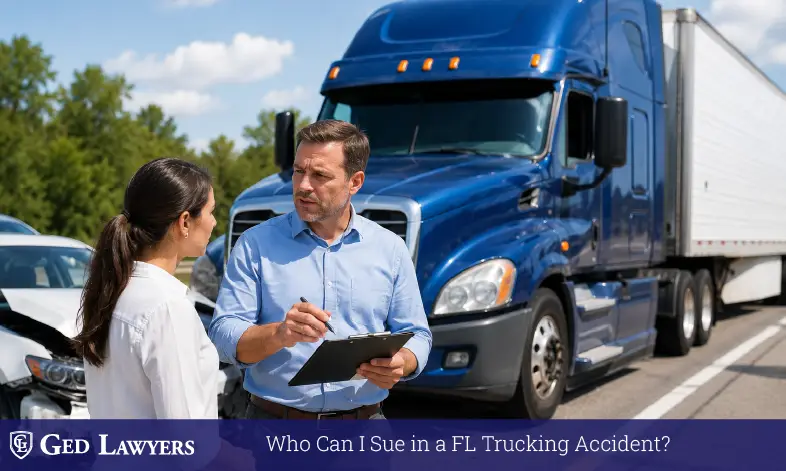
If you have been injured in a trucking accident, you are not alone. Last year approximately 107,000 semi-trucks and commercial trucks were involved in serious accidents. Commercial trucks can weigh up to 30,000 pounds, and the damage that they can cause physically, emotionally, and financially, can be catastrophic. If you have suffered serious injuries due to a reckless truck driver, you may be feeling overwhelmed by increasing medical bills and a lack of support. Depending on your injuries, a trucking accident can result in hundreds of thousands or even millions of dollars in damages. For most people, the only way to meet this burden is by bringing a personal injury lawsuit against the truck driver. But what happens when the truck driver does not have sufficient assets to cover the harm that they have caused you?

Suing the Trucking Company

In many cases, the truck driver is not the only party who is liable in a trucking accident. Often, additional parties can also be held liable and can be added to the lawsuit to cover damages. For instance, the company that the truck driver worked for may be held liable for your damages. While a truck driver may have been speeding or have fallen asleep at the wheel, the company that they work for may be held liable for this as well if the company put unreasonable deadlines on the truck driver, forced them to skip the rest breaks that they are legally required to take for safety reasons, or engaged in other behaviors or practices that enabled or required these actions.

Working with an attorney can help you determine whether the trucking company can be held liable. An attorney can use subpoenas to get relevant information, such as trucking logs, to determine whether the driver was taking required breaks and what the workload and distances traveled were in order to uncover potential negligence on the part of the company. In order to hold the trucking company liable, they must be found negligent. This means that the trucking company must have failed to meet the required standard of reasonable care. It may or may not come as a surprise to you that trucking companies often fail to meet this obligation.

In other cases, there are additional parties that can also be held liable, such as the manufacturer or supplier that the truck driver is making deliveries for. This can happen if the manufacturer or supplier over-loads or improperly loads a truck, which can lead to jack-knifing, and overturns. The manufacturer of the truck or components of the truck may also be held liable if it was a malfunction or defective part that contributed to or caused the accident. Because it can be complicated to determine all at-fault parties, it is helpful to consult with an experienced Florida truck accident lawyer.

Schedule a Consultation with our Boca Raton Trucking Accident Lawyers at Ged Lawyers, LLP

If you or a loved one has been seriously injured in a Florida truck accident, the experienced personal injury lawyers at Ged Lawyers, LLP are ready to fight to get you the compensation and support to which you are entitled. Contact Ged Lawyers, LLP today to schedule a free case review.

By : Clarissa Romero

June 8, 2022

Search

Categories

Recent Posts

Tags